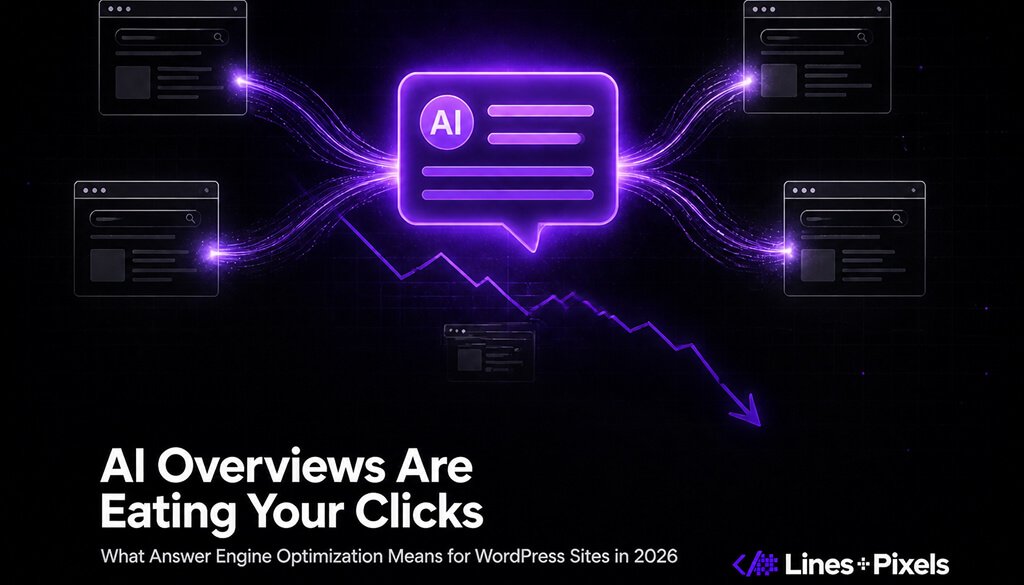
AI Overviews Are Eating Your Clicks: What Answer Engine Optimization Means for WordPress Sites in 2026
The traffic dashboard prepared by the client told a better story than we could: the rankings were staying the same, impressions remained level, and clicks were slowly decreasing from month to month. Nothing was wrong—the fact was that Google had begun to answer the question before anyone even reached the site.
This isn’t just a problem with one client’s SEO — it represents the major change in search this year. About 58.5% to 68% of Google searches now conclude without any click on a website, and when an AI Overview shows up on the results page the proportion of zero-click searches rises to about 83% (Click-Vision, 2026; Strategyc, 2026). For advertising agencies which have for years focused solely on improving their rank position, this figure should alter the way they talk to each of their clients.
Ranking #1 Doesn‘t Mean What It Used To
The unpleasant thing is that you can win the click-through race and yet still lose the overall campaign. AI Overviews now appear on about 48% of search engine results pages and reduce organic click-through rates by an average of 61% in all the cases where they are displayed (DeepMarketing, 2026). It is being mentioned in the AI-generated answer—not just appearing below it—that is what actually reaches the customer at the point when they make their decision.
The term that the industry has now begun to use is Answer Engine Optimization (AEO), and it is sometimes presented in conjunction with Generative Engine Optimization (GEO) when referring to platforms such as ChatGPT, Perplexity, and Gemini specifically. Although it’s useful to be aware of the difference it’s not worth worrying about too much: AEO relates to the answer experiences found within Google itself (such as AI Overviews and AI Mode), whereas GEO refers to the standalone AI assistants that users are increasingly turning to when searching. Both of these approaches are based on the same fundamental principle — structured, citable, and source-supported content (Brenton Way, 2026).
The traffic is still there; it‘s just been redistributed.
At first glance this might seem like a reason for concern, but there is in fact a genuinely useful positive aspect to the situation. Companies that are mentioned in AI Overviews receive about 35% more organic clicks and convert visitors at rates that are 4 to 9 times higher than those of average organic traffic (Strategyc, 2026), since a user who has read a summary and then clicked through is a visitor with a much higher level of intent than someone who is merely scanning ten blue links. It should also be noted that not all types of search query react in this manner: transactional searches aimed at making a purchase trigger AI Overviews far less
frequently than informational ones (DeepMarketing, 2026), meaning that e-commerce and service-booking pages are less affected by this change than blog posts and how-to articles.
As for agencies, they should stop assessing the success of their content solely on the basis of the number of clicks. A page may still be carrying out its function—such as building trust or getting the brand mentioned in an AI response—even if its total traffic is quietly falling.
What Actually Makes WordPress Content AI–Citable
Research carried out at Princeton and Georgia Tech showed that content which had been specifically structured using GEO methods resulted in an improvement in AI citation rates by 30 to 40 per cent (Princeton/Georgia Tech, KDD 2024, as cited in Strategyc, 2026). In the case of a WordPress site, this means specific, practical changes rather than a complete review of the content strategy:
Define the entity clearly. It is essential that the organisation, its founders, and its main services are clearly identified using schema markup (organisation, person, service types) since AI systems will only quote something after they have established who is making the statement.
Claims supported by sources are more reliably included in AI responses when they refer to a cited study or number — exactly the approach taken in this article.
Answer in a direct manner. Provide a brief and self-contained answer consisting of two to three sentences, placed immediately below a heading that poses the question, following the featured-snippet format which is used for most AI Overview content.
Signals of authorship and expertise: E-E-A-T (which stands for Experience, Expertise, Authoritativeness and Trust) acts as the trust filter that AI systems use when deciding what to summarize and what to cite, and the importance of E-E-A-T is increasing all the time as a ranking and citation factor (GoodFirms, 2026).
What This Means for Client Reporting
Should you be an agency and a client wants to know why their organic traffic has declined even though their rankings have remained stable, then this is very probably the explanation, not a result of a technical SEO failure. It’s important to proactively include AI Overview and AI Mode visibility as reporting metrics together with the usual rank tracking—since tools which keep an eye on brand mentions within AI answers are now just as necessary as classic SERP trackers were five years ago.
The Bottom Line
The zero-click search phenomenon is not just a temporary byproduct of the current AI hype cycle—this fundamental trend actually predates generative AI and has been gradually increasing since featured snippets and knowledge panels became more established (Digital
Applied, 2026). AI Overviews sped up a change that was already in progress. Agencies which continue to optimize exclusively for blue-link rankings are now focusing on an ever-narrower portion of the way in which people actually find answers.
Want to know if your client’s content is actually getting cited inside AI Overviews? Build with us — we’ll audit the schema, structure, and source signals that decide whether AI trusts your content enough to quote it.
References