We had a franchise client who was looking after 14 separate WordPress installations — one for each location — each with its own logins, its own versions of plugins, and its own gradually changing design. To update a single header image meant having to log in 14 times. That isn’t a website issue. That’s an operations problem disguised as a website problem.
Multisite does exactly what is needed in that situation, but the various agencies either overstate or understate it as often as not. That is the straightforward truth.
What Multisite Actually Is
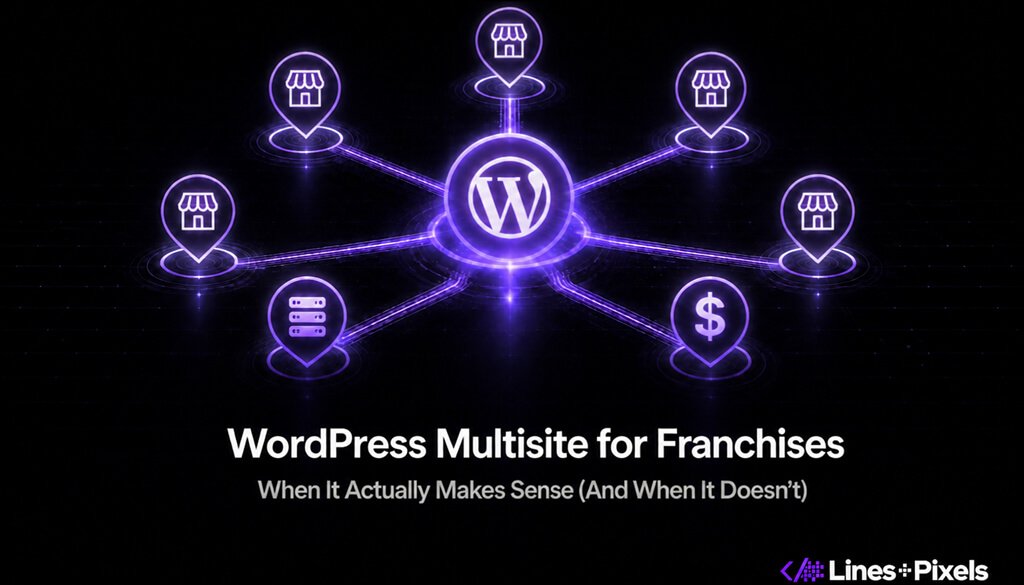
WordPress Multisite is a feature that is built into the core of WordPress rather than being available as a plugin and it enables a single installation of WordPress to function as a network that can host a number of separate websites. Each of these sites maintains its own content and users, and may also have its own domain, but they all use the same core code, themes, and plugins and are managed by a single Super Admin (WPPoland, 2026). In the case of a franchise, this generally takes the form of a URL such as locations.yourbrand.com/city-name or a dedicated domain for each location, with the corporate office in charge of the common design system and each location looking after its own local content.
The Resource and Cost Case
The efficiency case for Multisite is the simplest to support using figures. A Multisite network consisting of ten sites generally requires about 60% fewer server resources than ten separate WordPress installations which offer the same functionality (WPPoland, 2026) since only one codebase and one set of plugin updates have to be used rather than ten. Franchise networks usually operate between 50 and 100 sites at a single well-configured Multisite installation (WisdmLabs, 2026), and the figure cited for smaller operations is about five to fifteen sites, at which point the initial setup cost begins to clearly exceed the ongoing maintenance savings (WPSensi, 2025).
There is also a valid SEO reason which agencies frequently omit when making their pitch; franchises that use a subdirectory structure (such as /locations/city-name) achieve about two to three times the domain authority than those that have a separate domain for each location, since the authority of the various location pages is consolidated under a single root domain rather than being spread out over dozens (AuthoritySpecialist via Web Tonic, 2026).
Where Multisite Genuinely Fits
Franchise and multi-site brands have each location with its own address, opening hours, staff, and local promotions, while the corporate office maintains a consistent brand identity and
core features (WPSensi, 2025).
Chapter or affiliate-model organisations; consisting of a head office and a long series of local sites which are usually looked after by non-technical local staff, with brand consistency being more important than raw performance when scaling up (eSEOspace, 2026).
There are portfolios that involve more than one brand sharing the same infrastructure; this refers to various brands all belonging to the same parent company, each wanting to maintain its own identity but at the same time taking advantage of shared development resources and having a single team in charge of the updates.
Where Multisite Is the Wrong Call
Places that have truly different requirements; if even a few of the locations need custom functionality, different compliance rules, or separate update cycles, then imposing them all on a common network results in more trouble than it eliminates (WPPoland, 2026).
Small networks consisting of five sites or fewer. When the number goes below this threshold, the difficulty involved in setting up and hosting Multisite isn’t worth the effort—individual, simpler installations are sufficient and carry less operational risk.
The reason why multisite performance problems occur most often is not due to the architecture but because the amount of server resources needed is underestimated when planning. The infrastructure must be scaled to meet the total traffic of the network, not just that of any one site (DITS.agency, 2026).
The Trade–Off Agencies Need to Say Out Loud
Although multisite has a higher initial setup cost it does benefit from lower per-location expenses over time, whereas individual installations are less expensive to set up at the beginning but end up increasing the amount of maintenance work as the network expands (DazzleBirds, via Web Tonic, 2026). The real discussion that should take place with a franchise client at the proposal stage is not whether multisite is more powerful, but rather which cost curve matches your growth plan over the next three years.
What We Tell Clients
Before suggesting Multisite, we want to know three things: Firstly, how many locations are there at the moment and how many are realistically expected to be opened over the next two years? Second, do any of the locations have functionality or compliance needs that the others don’t? And third, who is actually going to handle the local content on a day-to-day basis — the corporate marketing team or the non-technical franchisees? The answers to these three questions are far more important than any theoretical list of Multisite features.
Managing a growing location network on scattered WordPress installs? Build with us — we’ll map out whether Multisite actually pays for itself at your scale before you commit to a rebuild.
References