The Numbers Don’t Lie
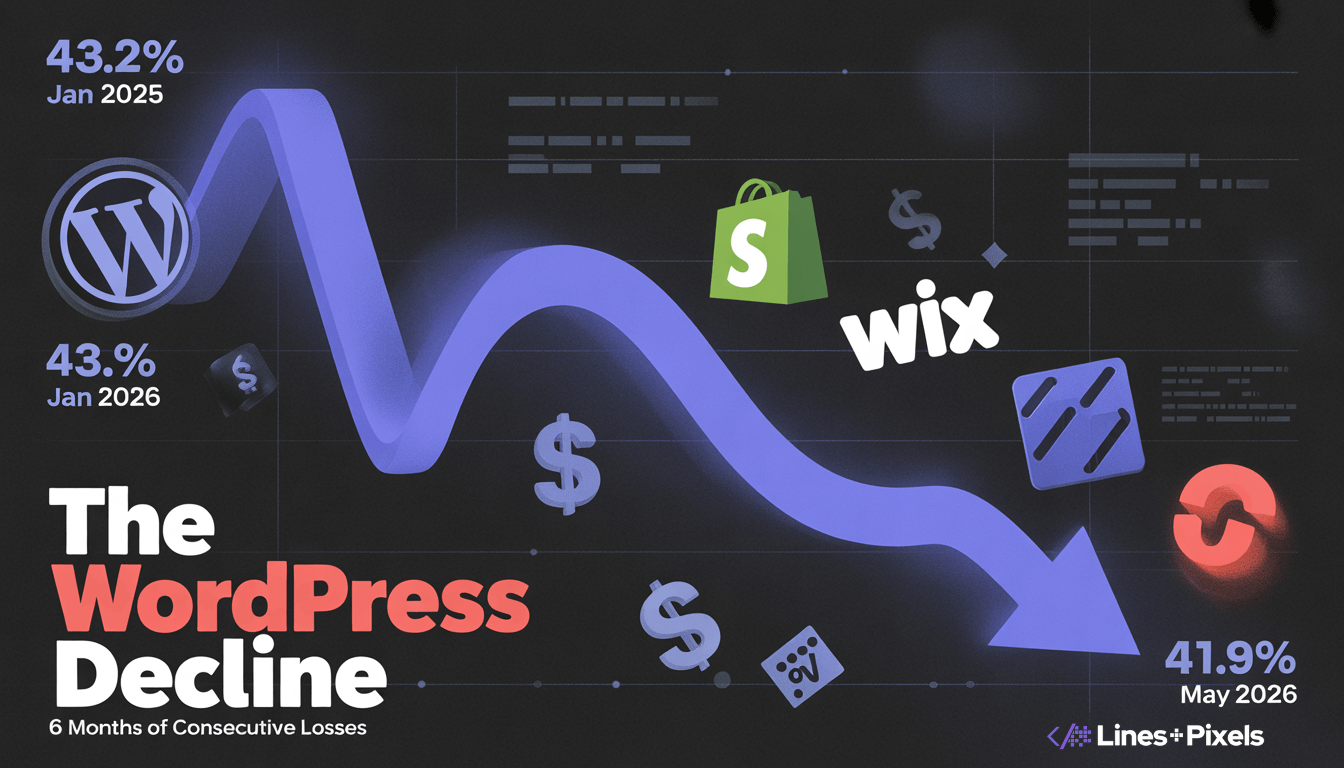
As of May 27, 2026, WordPress powers 41.9% of all websites globally, according to W3Techs (w3techs.com, June 2026). That might sound dominant — and it still is — but the trend line tells a different story. WordPress has lost market share for six consecutive months, dropping from 43.2% in December 2025 to 41.9% in May 2026. That’s a 1.3 percentage point decline in just half a year (Search Engine Journal, 2026).
To put that in perspective: WordPress’s nearest competitor, Shopify, sits at 5.1%. So even with this decline,
WordPress is still roughly 8x larger than its closest rival (wpzoom.com, 2026). The sky isn’t falling. But the
wind has changed direction.
Why Is WordPress Losing Ground?
Multiple factors are contributing. According to Search Engine Journal (2026), WordPress consistently ranks
last on Google’s Core Web Vitals performance comparisons from HTTP Archive — behind Wix, Shopify, and Squarespace. In an era where Google uses speed as a ranking factor, this matters. When a prospect compares a Wix site (faster out of the box) to a poorly optimized WordPress site (slower without work), the perception gap widens.
The competitive landscape has also shifted. Wix improved its performance metrics significantly. Shopify grew from 0.1% in 2014 to 5.1% today. And newer frameworks like Astro are growing exponentially — from 4.59 million npm downloads in January 2026 to 9.24 million by April (Search Engine Journal, 2026).
There’s also the community factor. Since late 2024, internal conflicts within the WordPress ecosystem —
particularly the public dispute between Automattic’s Matt Mullenweg and WP Engine — have created uncertainty. The W3Techs data shows market share held steady before the conflict and began declining
immediately after (Search Engine Journal, 2026).
What This Means for Your Agency
Here’s the critical insight: WordPress isn’t dying. It’s maturing. The HTTP Archive’s 2025 Web Almanac
describes this as a shift “from a focus on expansion to one on stabilization” (wpzoom.com, 2026). The decline is measured in tenths of a percentage point, not wholesale abandonment.
But the implications for agencies are real:
- Performance is now a competitive requirement, not a bonus. Clients who shop around will see faster Wix and Shopify sites. Your WordPress builds need to match or exceed those speeds.
- The”WordPress is biggest” sales pitch is weakening. You can’t just say “everyone uses WordPress” anymore. You need to say why your WordPress sites are better than the alternatives.
- Specialization wins over generalization. Agencies that can demonstrate speed, security, and builder expertise will retain clients. Generalist WordPress shops will feel the squeeze.
How to Adapt
First: build fast. Use performance-first builders like Breakdance, optimize images aggressively, implement
proper caching, and target 90+ PageSpeed scores on every project. Second: differentiate. Don’t sell “a
WordPress website.” Sell “a fast, secure, conversion-optimized website built on WordPress.” The platform is the engine, not the selling point. Third: diversify. Consider offering Shopify or Webflow builds for e-commerce clients who need platform-native features your WordPress stack can’t match.
Build for Performance, Not Just the Platform
WordPress still powers 41.9% of the web. It has 9x the market share of its nearest competitor. But the era of passive dominance is over. Agencies that treat performance, specialization, and client education as core competencies will thrive. Those that don’t will watch their market share follow WordPress’s.
If your agency’s WordPress sites aren’t scoring 90+ on PageSpeed, we should talk. Contact Lines + Pixels!
References: