Elementor vs. Breakdance: An Honest Comparison for Agency Owners (2026)
BLOG
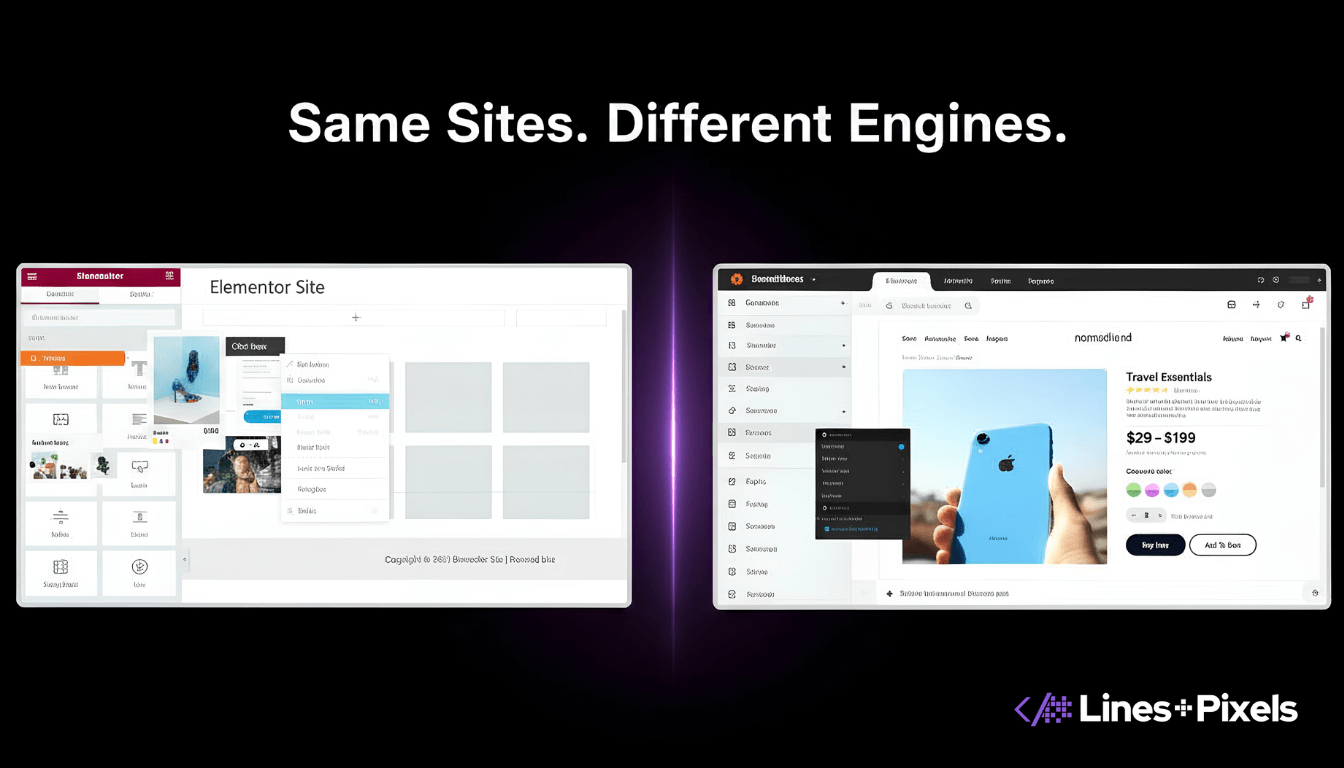
Every agency owner I’ve talked to in the last year has the same unresolved question: Elementor or Breakdance?
Here’s what the data actually says. Elementor powers over 10 million active WordPress installations — roughly 13% of all websites globally — making it the most popular page builder in the world (Colorlib, 2026). Breakdance, launched in 2022 by Soflyy (the same team behind Oxygen Builder), has grown to 40,000+ active installations with a reputation for performance-first architecture.
Both serve the same core market: agencies and freelancers building WordPress sites. Both let clients edit their own content. Both handle WooCommerce, forms, popups, and dynamic data. The difference isn’t capability — it’s philosophy, ecosystem, and the performance-to-feature tradeoff.
We’ve built 40+ projects in both. Here’s an honest comparison based on real data, not fanboy bias.
The Numbers That Matter
METRIC
ELEMENTOR
BREAKDANCE
Active Installations
10M+ (purethemes.net, 2026)
40K+ (purethemes.net, 2026)
Built-in Elements (Pro)
86 Pro widgets (brantleysites.com, 2026)
145 Pro elements (brantleysites.com, 2026)
PageSpeed Score (out of box)
70-85* (purethemes.net, 2026)
85-95 (purethemes.net, 2026)
Unlimited Site Pricing
$499/year (brantleysites.com, 2026)
$199.99/year (brantleysites.com, 2026)
Free Version
Limited but functional
80 elements, core features (breakdance.com, 2025)
Form Builder
Pro only
Free+ Pro (breakdance.com, 2025)
Popup Builder
Pro only
Free+ Pro (breakdance.com, 2025)
WooCommerceBuilder
Pro + add-ons
Native, included(brantleysites.com, 2026)
Elementor scores require aggressive caching and optimization plugins to reach 90+. Without optimization, expect lower number (brantleysites.com, 2026).
Performance: The Real Differentiator
This is where the gap is widest. In head-to-head testing by multiple independent sources, Breakdance consistently produces cleaner code output and faster load times.
In controlled tests, Breakdance sites scored 97 on mobile PageSpeed Insights compared to Elementor’s 79 (breakdance.com benchmarks, Feb 2025). Breakdance pages averaged 103.4 KB in size with 12 HTTP requests, versus Elementor’s 575.4 KB and 33 requests. That translates directly into faster load times and better Core Web Vitals — which Google uses as a ranking factor.
But — and this matters — Elementor can achieve strong scores with optimization plugins like WP Rocket, Perfmatters, and a CDN. The question isn’t whether Elementor can be fast. It’s whether your team will consistently do the extra work to make it fast.
Features: What You Get Out of the Box
Breakdance’s core pitch is value: more features included at a lower price. The unlimited license is $199.99/year versus Elementor’s $499/year — a $300 annual difference for agencies (brantleysites.com, 2026).
More importantly, Breakdance includes features that Elementor locks behind Pro or third-party plugins: form builder, popup builder, WooCommerce integration, dynamic data support, and CSS class management — all native.
Where Elementor wins is ecosystem. With 10 million users, you’ll find more tutorials, YouTube walkthroughs, third-party add-ons, and pre-made templates. If your team learns by following tutorials, Elementor’s community advantage is real.
The UI Reality: Can Clients Actually Edit?
Yes — on both builders. Breakdance uses a fixed left sidebar for elements and settings, with a live preview pane on the right. It supports inline text editing (click and type directly in the preview), searchable settings panels, responsive breakpoints, and a Structure view for page hierarchy (breakdance.com, Feb 2025). The interface is modern and genuinely intuitive — not just for developers, but for clients who need to make content updates.
Elementor’s UI is more polished after years of refinement. Clients who’ve used it before will find it familiar. But Breakdance is not the “developer-only” tool some claim it to be — the learning curve is Easy-to-Moderate, not steep (beplusthemes.com, 2026).
The Architecture Question: Classes, Not Class-First
Let’s clear up a common misconception. Breakdance is NOT a “class-first” builder — that’s Bricks. Breakdance uses CSS classes and has a Class Manager for efficient styling, but it’s fundamentally a visual builder. You don’t need to write CSS or understand class hierarchies to use it effectively. The visual controls are primary; classes are there for power users who want them.
Elementor also supports classes and global styles. Both builders let you work visually. The difference is that Breakdance’s underlying code output is cleaner — fewer nested divs, less inline CSS, smaller DOM size.
Our 3-Question Framework
We don’t force one builder on every project. Here’s how we decide:
What’s the team’s builder experience? Deep Elementor experience → Elementor. New build or willing to learn → Breakdance.
What’s the performance budget? Client needs 90+ PageSpeed without optimization work → Breakdance. Team has time for caching/CDN setup → Either.
What’s the feature need? Specific third-party add-on required → Elementor (larger ecosystem). Standard features (forms, WooCommerce, popups) → Breakdance (all native).
The Migration Reality Check
Switching builders means rebuilding. There is no automated migration tool. Elementor’s shortcodes stop rendering when you deactivate it. If you’re migrating, plan for a full page-by-page rebuild. We migrated a 22- page site last year — it took 4 days of focused work. Factor this into your decision; don’t assume you can switch mid-project without cost.
We will make the call for you and build it right.
The builder you choose is the skeleton of your digital business. In 2026, performance isn’t optional — Google uses speed as a ranking factor, and every second of delay costs conversions (purethemes.net, 2026).
At lines+pixels, we build in both. We chose Breakdance for most new projects because the value equation is hard to ignore: $300 less per year, more features included, faster out-of-the-box performance, and a UI that’s genuinely intuitive for both our team and our clients’ teams. But when a project requires a specific Elementor ecosystem tool, we don’t force a square peg into a round hole.
If you’re deciding between the two for your agency, book a 15-min call. We’ll walk through your specific project requirements and tell you which builder we’d recommend — and why. No charge, no pitch.
References:
brantleysites.com(2026). “Breakdance vs Elementor 2026: Which Builder Actually Delivers?” Marcus Brantley. Retrieved from brantleysites.com
Elevate your business with a custom-designed website that captivates and converts. Let our expert team craft a digital experience perfectly tailored to your brand's needs.