Web Accessibility Lawsuits Are Increasing: Why WCAG Compliance Is a Legal Risk in 2026, Not Just a UX Concern
An e-commerce client sent us a demand letter last quarter—their first one. The issues were ordinary: low-contrast text, missing alt attributes, and a checkout form with no labels. Nothing unusual. These are the kinds of problems that often slip through during a rushed launch. This time, though, they led to a settlement.
Agencies have long described accessibility as a best practice. In 2026, it must also be discussed as a legal exposure issue, because the data now supports that view.
Litigation Numbers Keep Climbing
Federal web accessibility lawsuits brought under Title III of the ADA reached 3,117 in 2025, which was a 27% jump from 2024 (Level Access, 2026; WCAGsafe, 2026). When state court filings are added in—especially the increase in New York and Illinois—the yearly total rises above 5,000 digital accessibility lawsuits (WCAGsafe, 2026). Mid-2026 figures are even higher: UsableNetʼs mid-year report, based on cases filed through June 14, 2026, forecasts about 6,176 digital accessibility lawsuits for the full year, setting a new record and representing nearly a 20% increase over 2025 (Abledly, 2026).
The plaintiff trend matters because it shows which businesses are most exposed. E-commerce made up about 79% of all digital accessibility lawsuits filed in the first half of 2026 (UsableNet via Abledly, 2026), while food service was a distant second at 14%. If your agency builds or maintains WooCommerce stores, this is not background noise—it is currently the most heavily litigated site category online.
Why Nearly Every Website Is at Risk
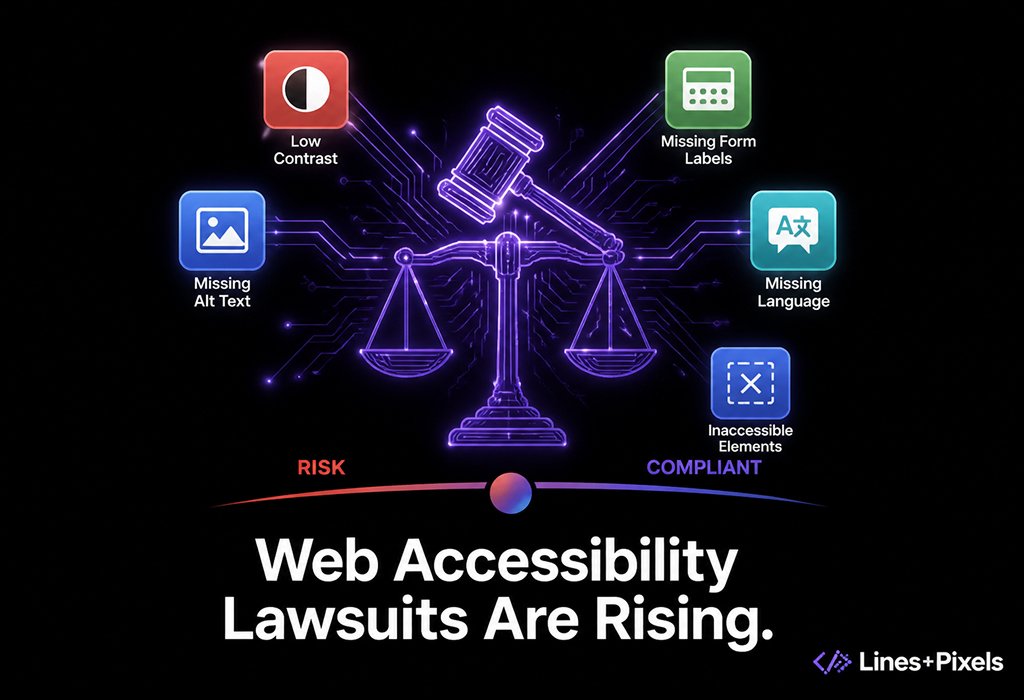
This is not a narrow compliance issue affecting only a few poorly built sites. The WebAIM Million, the largest yearly review of the web, found that 95.9% of the top one million homepages contain detectable WCAG failures, with an average of 56 accessibility errors per page (WCAGsafe, 2026; Accessibility.Works, 2026). Six easily fixable problems account for 96% of all detected WCAG failures: low-contrast text (79.1% of sites), missing alt text (55.5%), missing form labels (48.2%), empty links (45.4%), empty buttons (29.6%), and missing document language declarations (15.8%) (WCAGsafe, 2026).
None of these issues call for a redesign. They require a proper audit and a remediation list, which is exactly the kind of service agencies can offer once the client understands the legal risk.
The Overlay Widget Problem
One detail that often surprises clients is that installing an accessibility overlay widget does not significantly lower lawsuit risk. About 1 in 4 sites that were sued in 2025—24.9%, up from 22.65% in 2024—already had an overlay or widget in place when the lawsuit was filed (EcomBack via Abledly, 2026). In 2025, the FTC fined accessiBe, one of the best-known overlay vendors, $1 million for falsely suggesting that its widget could make any website automatically and continuously WCAG-compliant (WCAGsafe, 2026; Abledly, 2026). A real WCAG audit of the siteʼs actual code will surface the same kinds of issues a plaintiffʼs law firm would identify; a JavaScript overlay placed on top of broken markup does not solve the underlying problem.
That is a strong message for clients who have already been sold a “quick fix” widget and believe they are protected.
Regulatory Deadlines Agencies Should Watch
In addition to private lawsuits, two federal rules have directly raised compliance expectations:
- DA Title II (state and local government websites):** The DOJʼs April 2024 rule established WCAG 2.1 Level AA as the standard. An April 2026 Interim Final Rule extended the timeline: large public entities with populations over 50,000 must comply by April 26, 2027, and smaller entities by April 26, 2028 (Level Access, 2026; WCAGsafe, 2026).
- HHS Section 504 (healthcare and federal-assistance recipients):** A similar May 2024 rule set WCAG 2.1 AA as the standard under the Rehabilitation Act, and covered organizations with 15 or more employees now have until May 11, 2027, to comply (Accessibility.build, 2026).
These extensions do not affect private Title III lawsuits, which continue under the current statute without requiring a new rule and remain active regardless of these deadline changes (WCAGsafe, 2026).
What This Means for Agency Scoping
The practical change for 2026 is clear: accessibility should no longer be treated as an optional line item that gets removed when budgets are tight, especially for e-commerce clients. A baseline WCAG 2.1 AA audit should be part of every new build or redesign scope, not an add-on. For existing client sites, the six most common and relatively inexpensive failure types listed above should be the first items reviewed. And for clients already using an overlay widget who assume they are safe, presenting the litigation data is often the quickest way to secure approval for real remediation work.
Not sure how exposed a client’ssite actualyis? Build with us — we’l run a real WCAG 2.1AA audit againstthe site’s markup, not a widget scan, and show you exactly what a plaintiff’s
References